
When Equity Risk Premium Turns NEGATIVE
For generations, investors have relied on a simple idea: stocks should pay you more than safe assets because stocks are risky. That extra compensation is known as the equity risk premium. It is one of the most important concepts in finance, and it sits at the heart of how investors compare stocks with bonds, estimate expected returns, and value businesses.
Typically, investors ASK TO BE PAID to take on the equity risk. Today, INVESTORS ARE PAYING to take on the risk of uncertain future returns. Equity Risk Premium appears to have turned NEGATIVE.
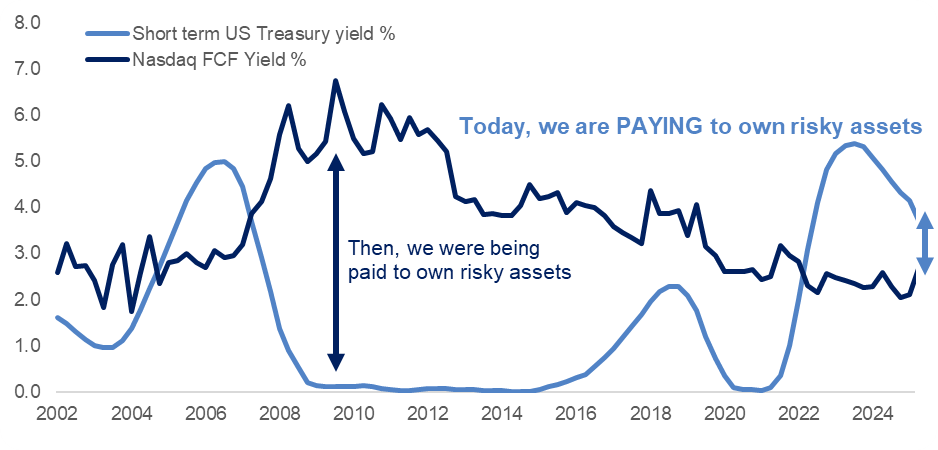
Data Source: Various – including Bloomberg, Yahoo Finance, Koyfin
The current market and portfolio allocation dilemma
This does not necessarily mean stocks must fall immediately. Markets can stay expensive for long stretches, especially when liquidity is abundant or investor optimism remains strong. But it does mean that future returns may be muted, and the margin of safety becomes thinner.
The equity risk premium is not just an academic number. It affects portfolio allocation, retirement planning, business valuation, and the cost of capital for companies. If ERP is compressed, the case for owning stocks over bonds weakens unless an investor has a strong view on growth, inflation, or earnings surprises.
For long-term investors, the key lesson is that return expectations should be forward-looking, not anchored to the past. A market can be expensive, admired, and still offer poor prospective returns. Conversely, a disliked market can offer an unusually high risk premium.
Instead of asking whether stocks are “cheap” or “expensive” in isolation, investors should ask a more useful question: What am I being paid to own this risk today? That is the essence of equity risk premium.
When the answer is clearly positive, stocks deserve a different place in a diversified portfolio than when the answer is barely positive or arguably negative. The equity market today is not offering a premium at all. It is offering an equity risk discount disguised as optimism.
Equity risk premium was built on a straightforward bargain: take more risk, earn more return. The tension in today’s market is that the bargain can disappear when valuations rise, bond yields reset, and expected returns compress. That is why the most important question for investors is not whether equities have historically beaten cash or bonds, but whether they are likely to do so from today’s starting point.
If you’re intrigued by these market dynamics and want personalized guidance on portfolio allocation amid compressed risk premia, reach out to us—Beacon Ridge Advisors is led by Pranay Laharia, a seasoned finance pro specializing in optimized investment strategies and financial planning. Let’s discuss how to navigate today’s environment for your goals.